
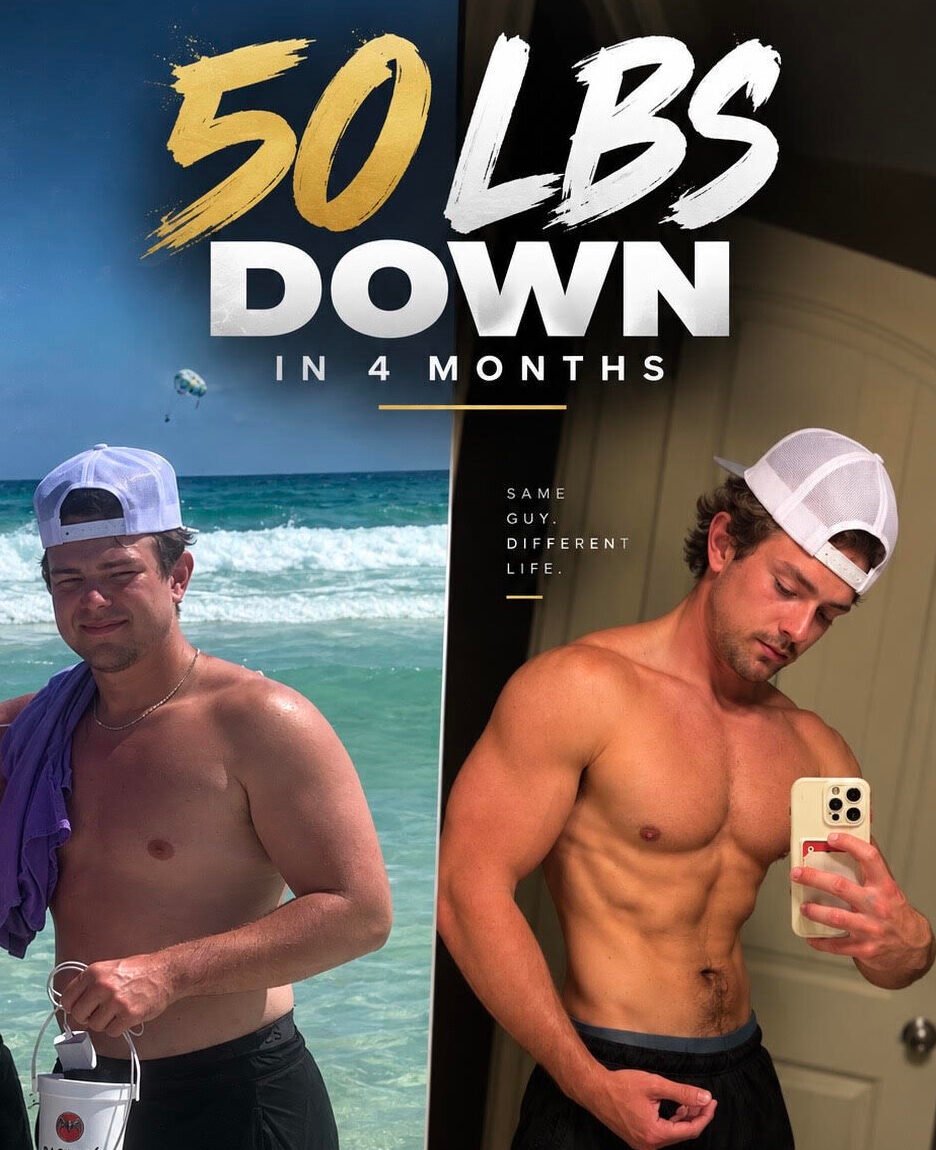
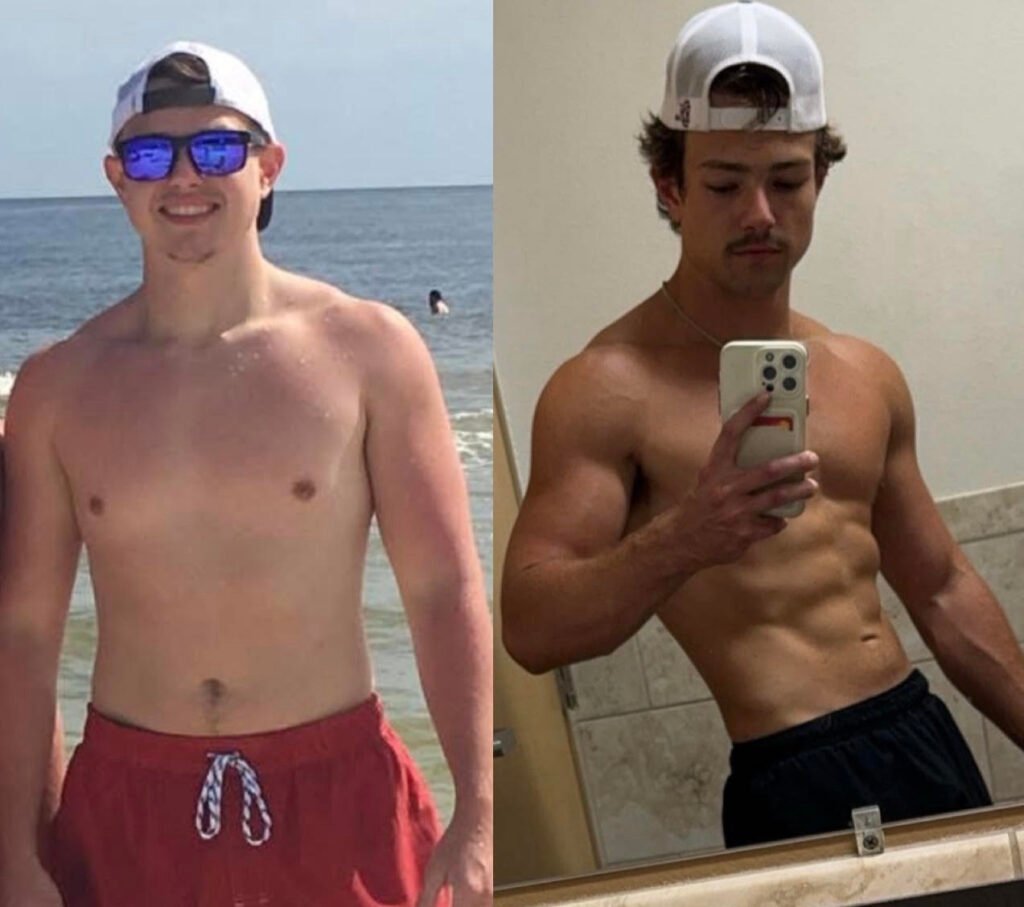
The last 10 pounds of fat can be very difficult to lose. Leptin levels dip, hunger can increase, and your body can try to conserve energy.
Losing the last pounds of fat is where most people get stuck. And this can be very frustrating, because losing the last 10 pounds is often where you start to see the biggest difference in how your physique actually looks.
For men, this is where your jawline starts to sharpen, your abs become clearly visible, your waist gets tighter, and that V-taper really starts to come through.
Your shoulders look broader, your chest and arms look more defined, and the muscle you’ve spent years building finally starts to pop.
For women, this is where your waist becomes noticeably tighter, your stomach looks flatter and more defined, your face looks leaner, and you start seeing more definition through your arms and legs.
These last few pounds can completely change the way your physique looks in the mirror, in pictures, and in your clothes.
Every time I’ve gotten really lean, I’ve used the Built Approach to get there.
The Built Approach was created specifically for getting to a low body fat percentage and losing those last 10 stubborn pounds.
It works whether you have 10, 50, or even 100 pounds to lose, but it really shines when you’re trying to reach that next level of leanness.
Here’s what a typical day using the Built Approach looks like for me:
- Morning: I’ll fast for the first 6–8 hours of the day using black coffee and sparkling water to help control my appetite.
- Break the Fast: I’ll break my fast with a piece of fruit.
- Lunch: I’ll do something light but satisfying. The goal of this meal is to satisfy my hunger but save the majority of my calories for later in the day.
This meal is also supposed to be convenient and shouldn’t take a long time to prep.
- Afternoon: I’ll have another piece of fruit 2–3 hours later to keep me full until dinner.
- Dinner: I’ll have my biggest meal of the day. This meal is going to be based around a pound of lean meat, the staple of my diet. (For women, I typically recommend around 8 ounces of lean meat.)
I’ll turn it into tacos, burgers, steak, or another big meal I actually look forward to eating.
The point is to make eating in a calorie deficit sustainable while allowing me to go to bed satisfied.
- Dessert: I’ll typically end the night with a 400-calorie dessert. This could be Sour Patch Kids, dark chocolate, or whatever else I’m craving.
In this article, I’m going to share 10 steps you can use to lose the last 10 pounds of fat and reach your leanest physique yet.
1. SET A CLEAR GOAL
Start by deciding exactly what your goal is. If you’re 180 pounds and want to get to 170, write down 170 pounds and make that number real.
Put it somewhere you’ll see every day. Your notes app, a piece of paper on your wall, or even your lock screen.
Seeing that goal every day keeps you focused on where you’re going.
Start imagining what you’ll look like 10 pounds leaner, how you’ll feel, and the person you need to become to get there.
2. MULTIPLY YOUR GOAL BODY WEIGHT BY 13
Take your goal body weight and multiply it by 13. This is the sweet spot I’ve found for setting calories when you’re trying to lose the last 10 pounds.
For example, if your goal is 170 pounds:
170 × 13 = 2,210 calories per day
If you want to be more aggressive, you can multiply your goal body weight by 12. I typically don’t recommend going lower than that.
For men: Cutting calories too aggressively can increase muscle loss, lower testosterone, hurt your training performance, and make recovery harder.
For women: Going too low in calories can disrupt hormones and menstrual function, hurt training performance, and negatively affect bone health over time.
The goal isn’t to eat as little as possible.
It’s to eat enough to keep your body functioning well while still losing fat.
3. EAT THE SAME THING EVERY DAY
I’ve never gotten ripped changing up my diet every single day or following a bunch of complicated recipes.
When you’re constantly changing your meals, it becomes much easier to miscalculate or incorrectly log your calories.
It also makes your diet harder to follow than it needs to be.
Keep it stupid simple. Find meals you enjoy, know exactly what’s in them, and repeat them.
If you start getting tired of your meals, change them weekly, not daily. Pick a few new meals for the upcoming week and repeat those instead.
IT IS VERY IMPORTANT THAT YOUR DIET IS BALANCED.
You want a balance of protein, carbs, and fats.
If you completely neglect one of them, you’re making the diet harder on yourself. Whether that means battling cravings, struggling with energy and training, or potentially affecting normal hormone function.
The goal is simple. Eat balanced meals you enjoy and make them easy enough to repeat.
4. WEIGH YOURSELF EVERY SINGLE DAY
If you want to get locked in and build momentum, weigh yourself every morning.
Do it under the same conditions. As soon as you wake up, use the bathroom, take your clothes off, and step on the scale.
Weighing yourself daily gives you real-time feedback on whether your diet is working.
As the weeks go by, you should start seeing the numbers trend down.
Just remember: your weight will fluctuate.
You might go up one or two pounds overnight even when you’re doing everything right.
Water, sodium, carbs, digestion, and other factors can all move the scale.
Don’t obsess over a single weigh-in. Pay attention to your weekly trend and your lowest weigh-in of the week.
If those numbers are moving down over time, you’re making progress.
5. DON’T BREAK YOUR MOMENTUM
As you start getting leaner, you’ll notice the diet starts to feel easier.
Your appetite is at bay, the scale is moving down every week, and you’re finally building momentum.
This is when you’ll be tempted to relax.
You’ll start thinking, “I’m making great progress. I can go grab a burger. I can have drinks with my friends. I deserve a few snacks.”
The problem is, when you’re losing the last 10 pounds and you have momentum, it can be really hard to regain that momentum once you lose it.
I’ve made this mistake so many times.
I’ll be getting lean almost effortlessly, everything is clicking, and then I decide to relax or change up my eating pattern.
Suddenly, it becomes so much harder to get back on plan.
Once you’re locked in and getting leaner by the day, don’t mess with what’s working.
Stay disciplined and keep going until you reach your goal.
6. DON’T LET HUNGER BREAK YOUR DIET
If you start feeling ravenous during your weight loss, give yourself permission to go a couple hundred calories over.
Have some fresh fruit, a little more potatoes, a protein bar, or something else filling.
Pushing through when you’re already extremely hungry, especially as you get leaner, can set you up for a binge.
You want to find the sweet spot.
You should feel some hunger when you’re getting lean, but you should never feel like you’re losing control around food.
And if you do binge, don’t beat yourself up.
Reflect on that day and figure out why you binged so you can prevent it from happening again.
I’ve had times where I’ve fasted too long, waited too long to have my big meal, and ended up eating more than I planned.
It happens.
Get back on track the next day. One bad night doesn’t need to turn into a bad week.
Don’t try to make up for it by drastically undereating the next day. Just return to your normal calories and keep going.
7. KEEP YOUR STEPS VERY, VERY HIGH
When I’m trying to lose the last 10 pounds, I do zero cardio.
I rely on brisk walking because it allows me to burn more calories without noticeably increasing my appetite.
The key is programming your steps into your day.
Walk first thing in the morning. Walk at night. Walk outside while you’re talking on the phone.
Get a walking pad and knock out steps while you’re working.
Find whatever works with your schedule and make walking part of your daily routine.
Walk, walk, walk, walk, walk.
10,000 steps is good for fat loss.
12,000 steps is great for fat loss.
At 14,000 steps, you’re becoming a fat-burning machine.
The more walking you can consistently work into your day, the more calories you’ll burn without having to rely on traditional cardio.
8. DON’T OVERDO THE LIFTING
Don’t overdo the lifting.
Both times I’ve lost 50 pounds and gotten down to a really low body fat percentage, I was only lifting 2–3 days per week.
Anytime I’ve tried lifting 4–5 days per week while getting really lean, I just get way hungrier.
I want to eat more to fuel my workouts, and it becomes much harder to stay in a calorie deficit.
When you’re losing the last 10 pounds, you don’t need to destroy yourself in the gym.
Two to three lifting days per week is plenty.
Focus on getting stronger, keeping the intensity high, and doing around four hard working sets per exercise.
You’re trying to lose the last 10 pounds while keeping your muscle. You don’t need to live in the gym to do that.
9. STICK TO LOW-VOLUME TRAINING
When you’re losing the last 10 pounds, stick to low-volume training.
Keep the weight heavier, the reps lower, and focus on getting stronger without doing a ton of volume.
Every time I’ve gotten really lean, this is how I’ve trained.
I’ll typically do an upper-body day and a lower-body day and keep the overall volume low.
High-volume training, meaning lighter weight and higher reps, has its place when you’re focused on maximizing muscle growth.
But when you’re trying to get really lean, you don’t need all that extra volume.
When you’re trying to lose the last 10 pounds, you want to finish your workouts feeling like you still have something left in the tank.
If you’re leaving the gym completely drained, you’re probably going to be a lot hungrier and want to eat more to recover from the workout.
That makes it much harder to stay in your calorie deficit.
I’ve experienced this plenty of times with leg days.
If I’m doing squats, leg extensions, Bulgarian split squats, and a bunch of additional work, I’ll be way hungrier afterward and have a much harder time sticking to my calories.
10. GET QUALITY SLEEP
When you get really great sleep, you have much greater willpower, fewer cravings, and it’s easier to stick to your fast.
You can also retain more muscle when you’re sleeping 7–8 hours a night versus only getting 5–6 hours.
If you’re trying to lose the last 10 pounds and your sleep is shit, you’re making everything harder.
Your hunger, cravings, recovery, and ability to hold onto muscle can all suffer.
One thing that has helped me is having a consistent sleep schedule.
I go to bed and wake up around the same time every day.
When you’re losing the last 10 pounds, sleep isn’t something you can ignore.
Get your 7–8 hours and treat it with the same importance as your nutrition.
WANT HELP GETTING LEAN?
If you’re ready to get lean and want me to personally help you build your diet and training around the Built Approach and lose those last 10 pounds, apply for 1-on-1 coaching through the link in my Facebook or Instagram bio.